
Attraction Marketing for LiveGood Affiliates
The livegood.fans Team•
We all know that one person. Every cookout, every group chat, every birthday party — they corner you within five minutes to tell you about the thing they're selling. You start avoiding them a little. Not because you dislike them, but because every conversation feels like a setup for a pitch.
Here's the uncomfortable truth: a lot of people building a business online accidentally become that person. And it doesn't work. The fix isn't more energy or a better script — it's a completely different approach called attraction marketing, where you grow your LiveGood affiliate business by becoming someone people genuinely want to learn from, instead of someone they screen calls to avoid. This guide breaks down what that actually looks like, why the pushy approach quietly backfires, and how to do it in a way you'd feel good about.
What attraction marketing actually is
Attraction marketing is simple to define and harder to do: instead of chasing people and pitching them, you publish helpful, honest content and share real results, so the right people come to you already curious. You stop interrupting and start attracting.
The difference shows up in the very first move you make:
- Chasing says: "Hey, you should buy this / join my team." It centers you and your goal.
- Attracting says: "Here's a problem I solved and how — judge for yourself." It centers the other person and lets them raise their hand.
That's the heart of attraction marketing vs pushy sales. One treats every contact as a prospect to convert. The other treats people as people, builds trust first, and trusts that genuine interest converts itself. You're not memorizing rebuttals to objections — you're being useful in public until the question becomes "how do I do what you're doing?"
The goal isn't to be more persuasive. It's to be the obvious, trustworthy answer when someone is already looking.
Why pushy sales tactics quietly fail
Pushiness doesn't fail loudly. Nobody tells you they muted your stories or stopped opening your messages. It fails quietly — in unreturned texts and slow fades — which is exactly why so many people keep doing it. The data, though, is blunt about why it doesn't land.
First, people simply don't want to be sold to. 71% of buyers say they'd rather research a purchase on their own than talk to a sales rep, according to HubSpot. They want to figure it out, not be cornered. And when sellers push anyway, it shows: half of prospects say sellers come across as pushy — while only 17% of salespeople think they do (HubSpot Research). That gap is the trap. The person doing the pitching almost never realizes how it feels on the other end.
Second, pushy tactics don't just whiff — they cost you future goodwill. 65% of customers say they've stopped buying from a brand over something they considered distrustful (Salesforce). When you're the brand — and as an affiliate, you are — a single pushy season can close doors that stay closed.
Third, the raw interruption math is brutal. The average cold call success rate fell to about 2.3% in 2025 — roughly 43 dials to reach one real conversation (Cognism). Cold email isn't much kinder: across a dataset of more than 20 million sent messages, basic, low-personalization cold emails reply at around 7% (Woodpecker), meaning 90%+ go ignored. People are voting with their attention, and the vote is "no."
The data: why trust beats the hard sell
So if interruption is fighting uphill, what actually moves people? The pattern across decades of research is remarkably consistent: people decide based on who and what they trust — and they trust people they know far more than they trust ads or cold pitches.
The chart below stacks the most-trusted growth channels against the least, using each channel's own headline figure. Notice that the bars at the top — the ones built on real recommendations and discoverable content — are exactly the ones attraction marketing relies on. The bars at the bottom are the cold, interruptive tactics most affiliates default to.
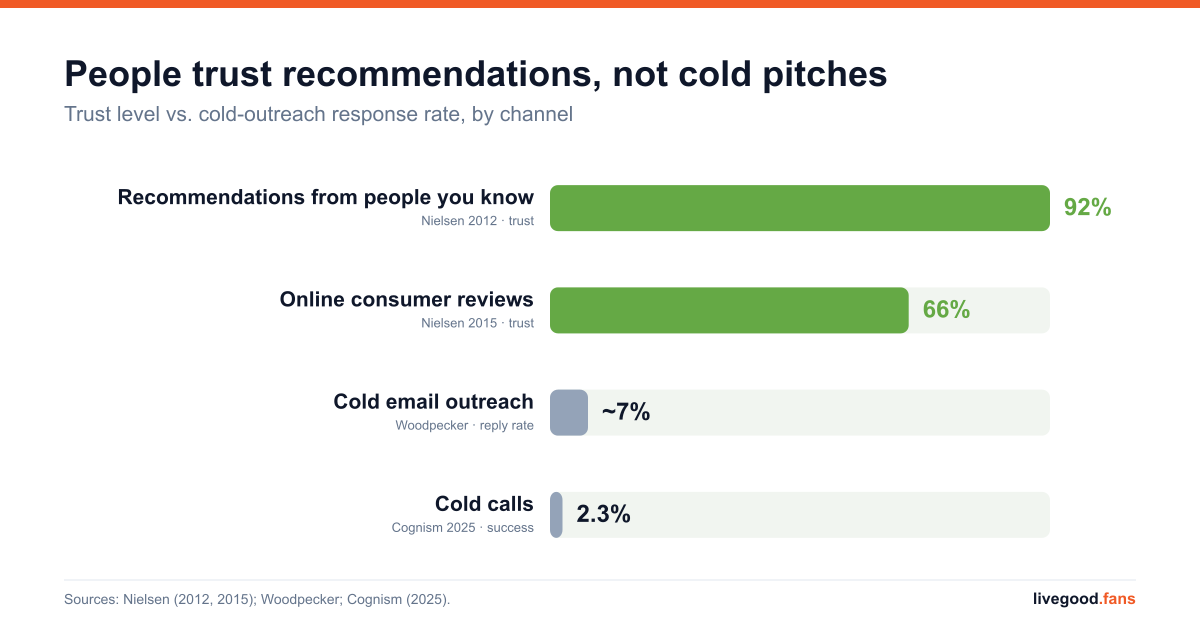
The story the data tells is hard to argue with. 92% of consumers trust recommendations from people they know above every other form of advertising (Nielsen, 2012). That's the single highest-trust channel there is — and it's free, if you've earned it. Trust in pure social proof is strong too: 66% of consumers trust online consumer reviews and opinions (Nielsen, 2015), well above most paid formats.
Compare that with where the cold tactics land — a ~7% cold email reply rate and a 2.3% cold call success rate from the sources above. The gap between "a friend told me" and "a stranger pitched me" isn't a few points. It's the difference between how people want to discover things and how they actively defend against being sold. Roughly 29.5% of internet users run ad blockers (GWI, 2025) specifically so they never see interruptive ads — that's how strongly people reject the cold approach.
And it's not only about trust — it's about money over time. Peer-reviewed research tracking thousands of customers found referred customers have about 16% higher lifetime value and are 18% less likely to leave (Schmitt, Skiera & Van den Bulte, Journal of Marketing, 2011). The people who come to you through trust don't just convert better — they stay longer.
How to apply attraction marketing as a LiveGood affiliate
Theory is nice, but here's the part you can actually do this week. None of it requires a big audience or fancy tools — just consistency and honesty. Here's how to grow your LiveGood downline by attraction instead of pursuit.
1. Lead with real product results
Don't open with the opportunity. Open with what the products did for you. The better sleep, the energy, the money you stopped spending elsewhere — specific, true, your own. This is the most natural form of word of mouth, which McKinsey found is the primary factor behind 20–50% of all purchasing decisions. People can argue with a pitch. They can't argue with your genuine experience.
2. Teach, don't pitch
Make content that's useful even to someone who never buys a thing: how you read a supplement label, how you built a simple morning routine, what you wish you'd known starting out. Helpfulness compounds. Content marketing generates roughly 3x as many leads as outbound while costing about 62% less (Demand Metric), because teaching builds an audience that comes back, while pitching burns through one.
3. Share your story
People don't follow products — they follow people. Why you started, what you were skeptical about, what changed your mind. Vulnerability and honesty are magnetic in a way no sales script ever is. Your story is the one thing no other affiliate can copy.
4. Let your content do the chasing
This is the mindset shift. Instead of DMing 50 people today, publish one genuinely good post that keeps working while you sleep. Most people research long before they ever reach out — 96% do independent research before talking to anyone (HubSpot). If your honest content is what they find during that quiet research phase, you're the obvious person to ask. The content does the chasing so you don't have to.
5. Build trust before the ask
Earn the right to make an offer by being useful first, repeatedly, with no strings. By the time you do invite someone to look at the opportunity, it lands as a friend sharing something good — not a stranger closing a deal. That's the whole reason attraction works: the ask arrives after the trust, not before it.
6. Make joining easy and pressure-free
When someone is ready, get out of their way. A clear, low-pressure next step beats a hard close every time, especially since 67% of buyers say they prefer a rep-free, self-directed buying experience (Gartner). Point them to the info and let them choose.
Using livegoodpartners.com to grow your team the right way
Attraction marketing brings people to you. The next question is how you organize and support them without slipping back into spreadsheet chaos or losing the personal touch that got them interested in the first place. That's where livegoodpartners.com comes in — it's the affiliate platform and back-office that helps you track, organize, and grow your team in a way that stays ethical and human.
Used well, a good back-office turns attraction into a system you can actually keep up with:
- See your team clearly. Instead of guessing who's active or who just joined, you have a real view of your group — so you can show up for the people who need a hand at the right moment.
- Follow up with care, not spam. Knowing where each person is in their journey means your check-ins are timely and relevant, the opposite of the "blast everyone the same message" trap.
- Track what's actually working. When you can see which content and conversations lead somewhere, you double down on the honest stuff that resonates and quietly retire what doesn't.
- Stay organized as you grow. Attraction marketing tends to compound. A platform that scales with you means you can welcome new partners properly instead of dropping the ball as the numbers climb.
The tool doesn't replace the relationship — it protects it. It keeps the admin from eating the time you'd rather spend being genuinely helpful to your team. That alignment matters: LinkedIn found relationship-driven social sellers create 45% more opportunities than peers who don't engage that way. Organized, relationship-first growth simply outperforms scattered hustle.
An honest word on expectations
Here's the part most "join my team" posts skip. Attraction marketing is not a shortcut, and it is not a guarantee. Results vary widely and depend entirely on the work you put in, the consistency you bring, and a fair amount of patience. No one — not us, not anyone — can promise you a specific income, and you should be skeptical of anyone who tries.
What we can tell you honestly is this: attraction compounds slowly. Your first month of content might feel like shouting into an empty room. Then, somewhere down the line, a post you almost didn't publish brings you someone perfect, and you realize the quiet months were the foundation. The people who win at this aren't the loudest — they're the most consistent and the most honest.
Integrity beats shortcuts every time, and not just morally. The pushy operator burns their network once and has nothing left. The person who builds trust builds something that keeps paying forward — which is exactly why 88% of consumers still trust recommendations from people they know above every other channel (Nielsen, 2021). Trust is the asset. Guard it, and the growth follows.
Frequently asked questions
What is attraction marketing in simple terms?
Attraction marketing means publishing helpful, honest content and sharing real results so interested people come to you, instead of chasing or pitching people who didn't ask. You become someone worth following rather than someone to avoid.
How is attraction marketing different from pushy sales?
Pushy sales interrupts people and tries to convert them on the spot; attraction marketing earns trust first and lets people raise their hand when they're ready. That's why it works — 71% of buyers say they'd rather research on their own than be sold to (HubSpot).
Can attraction marketing really help me grow my LiveGood downline?
Yes, because it's built on the way people actually decide: 92% of consumers trust recommendations from people they know above all advertising (Nielsen). Genuine content and real results attract the right people far more reliably than cold outreach.
How does livegoodpartners.com fit in?
livegoodpartners.com is the affiliate platform and back-office that helps you track, organize, and support your team as it grows — so your follow-ups stay timely and personal instead of slipping into spammy mass messages.
Will I make money doing this?
Results vary and depend on your effort, consistency, and patience — there are no guarantees of any specific income. Attraction marketing tends to compound slowly, so treat it as a long-term, relationship-first approach rather than a quick win.
Ready to start the right way?
If this approach feels like you — helpful, honest, in it for the long game — there's room for you here. Build trust, share what you genuinely love, and let the right people find you.
When you're ready to take the step, Join LiveGood and start building on a foundation of trust. Want a deeper playbook first? Grab our free LiveGood affiliate guide for the practical walkthrough, and browse the blog for more honest, no-hype guidance on growing your business.