LiveGood vs. Wrapping Paper: What Your Fall Fundraiser Actually Earns
LiveGood Fans•
It's October, which means the order forms are coming home. Wrapping paper. Cookie dough. A box of chocolate bars that somehow ends up half-eaten in the minivan. Every one of them promises your group 40–50% profit — and when someone suggests a LiveGood fundraiser instead, the first question at the booster meeting is always the same: "Why would we take 20% when we can keep half?"
It's a fair question. This post answers it with real numbers — the same group, the same supporters, the same year — so your board can decide with a calculator instead of a hunch. Spoiler: the percentage is the wrong thing to compare. What matters is how many times you get paid.
What a fall catalog fundraiser actually pays
The classic fall fundraisers are popular for good reasons: families know them, grandparents expect them, and the margins are real. Typical published terms look like this:
- Wrapping paper and catalog sales commonly pay the group about 40–50% of sales.
- Cookie dough programs commonly pay around 40%, and some vendors tier the rate by volume — a smaller group earns less per tub than a big one.
- Chocolate bars — World's Finest, for example, advertises 50% profit (about $40 on an $80 box) on qualifying orders of 200 boxes; smaller orders typically earn less.
What those percentages don't show is the work wrapped around them: counting order forms, collecting cash and checks, sorting deliveries by student, chasing the families who haven't picked up, and paying the vendor invoice on deadline. And when the sale ends, so does the money. Next fall, you start from zero.
What a LiveGood fundraiser pays
LiveGood's published terms are short: your organization earns 20% on every initial order and 10% on recurring orders for life. It's free to sign up, there are no upfront costs, and LiveGood provides the flyers, tracking, and a personalized link for every student, player, or member.
There's nothing to sort or deliver and no cash to collect — supporters order through a link and LiveGood ships to their door. And the products are things families already buy every month: multivitamins, organic greens, coffee, protein, magnesium. That last part is the whole story, because consumables get reordered.
The side-by-side math
Let's run both fundraisers for the same group. We'll keep the assumptions simple and identical:
- 100 supporters each place one order during the fall campaign.
- The average order is $40 on either side.
- The catalog sale pays a middle-of-the-road 45%.
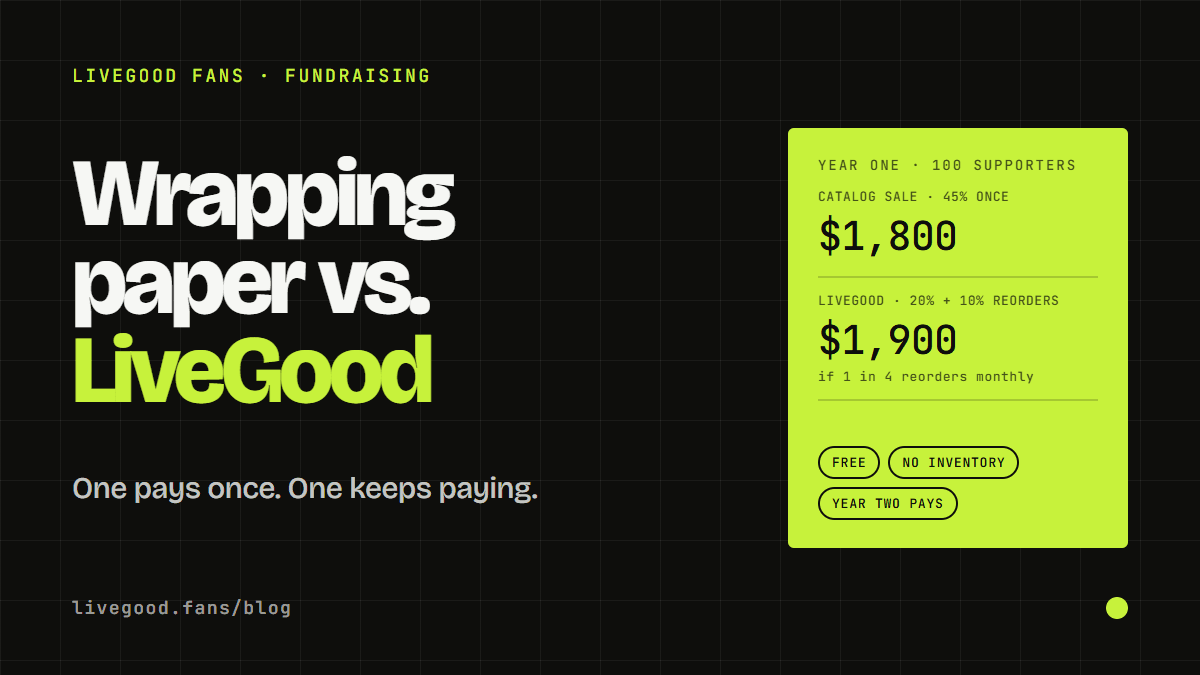
The catalog sale: 100 orders × $40 = $4,000 in sales. At 45%, your group keeps $1,800. That's the final number — the sale is over.
The LiveGood fundraiser: the same $4,000 in first orders at 20% earns $800. Lower, right away. But every supporter who keeps reordering a $40 order each month adds $4 to your group, every month. Over the remaining 11 months of the year, that's $44 per steady reorderer. Here's how the first year shakes out depending on how many supporters stick with it:
| Supporters who reorder monthly | LiveGood, year one | Catalog sale, year one |
|---|---|---|
| None | $800 | $1,800 |
| 1 in 5 (20 people) | $1,680 | $1,800 |
| 1 in 4 (25 people) | $1,900 | $1,800 |
| 1 in 3 (33 people) | $2,252 | $1,800 |
| 1 in 2 (50 people) | $3,000 | $1,800 |
The break-even point is easy to remember: if about 1 in 4 supporters keeps reordering, the LiveGood fundraiser matches the catalog sale within the first year. Everything past that is extra.
Now look at year two. The catalog sale pays nothing until you run a whole new campaign. On the LiveGood side, those same 25 steady reorderers would bring in another $1,200 ($4 × 25 people × 12 months) without a single new order form — and anyone your group adds next fall stacks on top.
An honest note on the math: this is an illustration, not a forecast. Real reorders taper — some people stop, some order more, some order less. The point isn't the exact dollar figure; it's the shape. One fundraiser pays once. The other keeps paying for as long as your supporters keep using the products.
Where the catalog sale still wins
We'd be doing your board a disservice if we pretended the old way has no advantages. It does:
- Cash up front. If you need $2,000 for uniforms by November, a one-time sale gets you there faster.
- Impulse buys. Grandma will buy a roll of wrapping paper she doesn't need. She may not want a monthly greens powder.
- Familiarity. Some communities expect the fall catalog, and that habit is worth something.
Where LiveGood wins
- It keeps paying. 10% on recurring orders for life means a supporter you reach this October can still be funding your group next October.
- No money handling. No cash envelopes, no checks, no invoice deadline, no delivery night in the school gym.
- No geography. A link works for the aunt three states away just as well as for the neighbor next door.
- It matches the mission. A team that trains hard or a school that teaches healthy habits gets to fund itself with vitamins instead of candy.
- It costs nothing to try. No sign-up fee, no inventory, no minimums.
You don't have to choose
Here's what many groups land on: keep the fall sale if it works for your community, and add a LiveGood link as the year-round fundraiser running underneath it. The catalog sale covers this season's budget. The LiveGood link builds an income stream that's still there when next season's budget comes due. Put the link on the order form, in the team newsletter, and in the email that goes out with the delivery schedule.
How to pitch it to your PTA or booster board
Boards approve what they can explain in one sentence. Bring these three points:
- "It's free and risk-free." No upfront cost, no inventory, no money to collect.
- "It's 20% now and 10% every time they reorder." Our supporters already buy vitamins and coffee somewhere.
- "If 1 in 4 supporters reorders, it matches our catalog sale — and it keeps going next year."
Then show them the table above. It does the convincing.
If you're the one bringing LiveGood Fundraising to local schools and teams, it helps to have something to leave behind. Our LiveGood Fundraising business cards carry a QR code that sends coaches, teachers, and group leaders straight to your fundraising signup link — and a LiveGood Fundraising hoodie starts the conversation at the game before you say a word.
Frequently asked questions
Doesn't a 45% catalog sale beat a 20% fundraiser?
On a single order, yes. Over a year, it depends on reorders. Using the same 100 supporters and a $40 average order, a LiveGood fundraiser catches up with a 45% catalog sale once about 1 in 4 supporters keeps reordering monthly — and the catalog sale pays nothing in year two unless you run it again.
What does LiveGood Fundraising pay?
LiveGood's published terms are 20% on every initial order and 10% on recurring orders for life, paid to your organization for orders placed through your fundraising links.
Does it cost anything to start?
No. LiveGood Fundraising is free for organizations and participants. There's no upfront purchase, no inventory, and LiveGood provides flyers, tracking, and personalized links.
Can we run a LiveGood fundraiser alongside our wrapping paper sale?
Yes. Nothing stops a group from running both. Many groups use the catalog sale for this season's budget and keep a LiveGood link running year-round for recurring income.
Who handles orders and delivery?
LiveGood does. Supporters order through your group's or a participant's link, pay LiveGood directly, and the products ship to their door. There's nothing for volunteers to sort, deliver, or collect.
How do we get started?
Register your organization for free on the LiveGood Fundraising signup page. Every participant gets a personal tracking link, and your campaign can be live the same week.
Run the numbers for your group
Swap in your own supporter count and average order and the math works the same way: the catalog sale is a one-time check, and a LiveGood fundraiser is a check that keeps coming. New to the program? Start with how LiveGood Fundraising works, see campaign ideas for schools, teams, churches, and gyms, or visit our LiveGood Fundraising page. Ready now? Register your organization free.
The figures above are illustrations built on stated assumptions, not a prediction or guarantee of earnings; results depend entirely on the orders and reorders your links generate. Catalog fundraiser rates vary by vendor and volume. LiveGood products are not intended to diagnose, treat, cure, or prevent any disease.