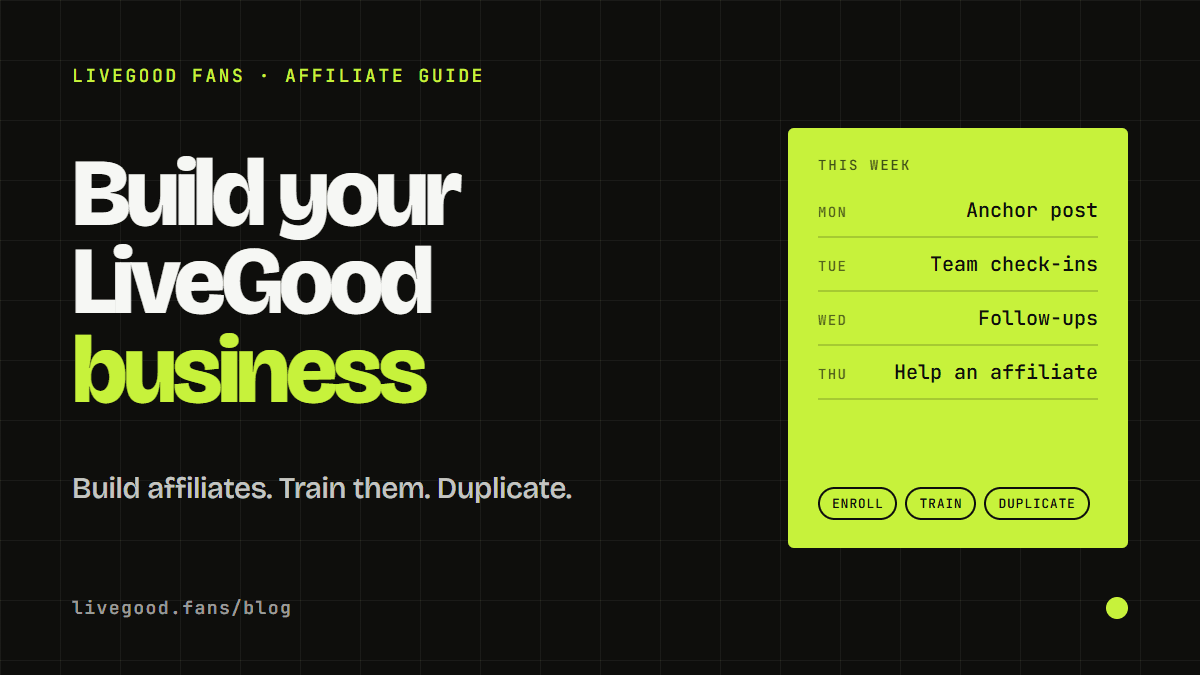
The LiveGood Affiliate Business: How to Build and Train a Team That Duplicates
LiveGood Fans•
A LiveGood affiliate business is simple to start and easy to underestimate. You pay $49.95 to join as a member and affiliate ($9.95 for the first month of membership plus a one-time $40 affiliate fee), you get a replicated website and a back office, and from there it is up to you. There is no inventory, no autoship requirement, and no boss. There is also no automatic success. Here is what separates a real business from a side hobby: you do not build it alone. A LiveGood affiliate business grows when you enroll affiliates and train them to do what you do. Then they teach the next people the same way, and your results no longer depend only on your own hours. That is duplication, and it is the most important part of this guide. Social media, content, and conversations are how you find the right people. Training them is how you keep a business growing. Below you'll find both, a weekly plan you can start this week, and the LiveGood rules you need to know before you post anything.
What a LiveGood affiliate business actually is
LiveGood is a membership wellness company: members pay $9.95 a month (or $99.95 a year) for access to member pricing on supplements, skin care, and other products, with no purchase requirement. Affiliates are members who have also paid the $40 affiliate fee so they can earn in three ways: when the people they refer join as members, when they sign up as affiliates, and when they buy products. The official pay plan calls it "Earn Income 7 Ways." Weekly Fast Start commissions pay $5 for each new member you refer and $20 for each new affiliate, or $25 when someone joins as both. Retail and customer acquisition commissions pay on product orders, and monthly matrix and matching commissions come from memberships that keep renewing. If you want the full breakdown, our walkthrough of how LiveGood affiliates actually get paid covers every stream, and the official LiveGood pay plan is the final word.
One line from LiveGood's own Policies and Procedures shapes everything else in this article: "It is possible that you will NOT earn any income." Commissions come from real sign-ups, renewals, and orders, so nothing is paid for simply joining. Anyone who promises you, or your prospects, a specific result is breaking the rules. Treat your LiveGood affiliate business as a real small business that grows with consistent effort, not a ticket that pays out on its own.
The heart of the business: build affiliates and train them to duplicate
You can earn from your own referrals and customers, but one person only has so many hours. The LiveGood pay plan is built around teams, and it rewards the affiliates who help other affiliates succeed:
- Fast Start commissions go deep. The weekly Fast Start commission is paid through your enroller tree, not just on the people you personally refer. At every rank you earn 50% of the Fast Start amount on your own referrals, plus smaller percentages on sign-ups made by the affiliates below you. The number of levels depends on your rank, as the official pay plan shows.
- Matching bonuses reward helping others earn. You earn a 50% match on the matrix commissions of the affiliates you personally enroll. From Silver rank up, the match extends to deeper generations of your team. The only way to grow that is to help your affiliates build their own teams.
- Ranks are team achievements. Bronze requires 2 personally enrolled active members. Every rank above that counts active members across your whole enroller tree. Silver, for example, requires 20 active members in total, and the higher ranks can be reached through legs led by other ranked affiliates. See the official rank qualifications for the exact requirements.
Put simply: an affiliate you enroll and then leave on their own usually goes quiet. An affiliate you enroll and train is far more likely to stay active, find their own people, and teach them the same way. None of this is automatic, and no one can promise results. But if you want this to be a business rather than a hobby, this is the work that matters most.
Keep the system simple enough to copy
Duplication only works if a brand-new affiliate can do the same thing you do, starting this week, without your personality, your network, or your years of experience. Before you teach anything, ask: could someone with an hour a day and no marketing background copy this? If not, simplify it. The weekly plan later in this guide is a good starting point to hand straight to a new affiliate: use the products, pick one platform, publish one anchor piece a week, start two conversations a day, and follow up.
Onboard every new affiliate in their first 48 hours
New affiliates are most motivated in their first few days. Reach out personally the same day they join and walk them through a short checklist:
- Place their first product order and pick what they will actually use.
- Find their tour and website links under "My Websites" and their prospects under "My Referrals."
- Read the key rules: no income claims, no health claims, identify as an independent affiliate.
- Set up their profile on one platform and write their "why I joined" post.
- Write a list of people they would genuinely like to share LiveGood with.
- Join your team chat or community, and put the weekly training call on their calendar.
Train by doing it together
People learn this business by watching it done, then doing it with help, then doing it alone. Help each new affiliate with their first few conversations, including three-way chats where you answer the questions they cannot yet answer. Review their first posts with them for tone and compliance. Show them how you follow up. The goal is to make yourself unnecessary as quickly as possible.
Teach them to teach
Real replication happens when your affiliates start onboarding their own new affiliates with the same checklist and the same weekly plan. Once someone on your team enrolls their first affiliate, coach them through that person's first 48 hours instead of doing it for them. That is how a team grows past what one person could manage.
Build a team culture people want to stay in
- A weekly rhythm. Attend the corporate or team training call together, and share one takeaway in your team chat afterward.
- Recognition for activity, not income. Celebrate someone's first post, first conversation, or new rank. Never post earnings.
- Lead by example. Your team copies what you do, not what you say. If you stop posting and following up, so will they.
- Stay in touch. A quick weekly check-in with each newer affiliate ("What did you do this week? Where are you stuck?") keeps people active far longer than any hype.
A compliance note for team leaders: if you share a building method, script, or system with 20 or more people, LiveGood's policies require the standard "consult with your upline" disclaimer. Never recruit people from other LiveGood teams. When you invite someone to become an affiliate, be honest about expectations: it is a real business that takes consistent work, and earnings are not guaranteed.
Get the foundation right before you post
Most new affiliates start posting links on day one. The ones who last spend their first week setting up. Do these yourself first, because they become the checklist you will hand to every affiliate you enroll:
- Use the products yourself. Order what you would actually use every day. Your honest experience is the most valuable content you will ever have, and nobody can copy it.
- Find your links. Your replicated websites and tour links live under "My Websites" in the LiveGood back office. People who take your tour show up under "My Referrals." Bookmark both.
- Read the Policies and Procedures once. The official document is 17 pages. Reading it now will save you from a removed post or a warning later. The short version is in the rules section below.
- Clean up your profile. Pick one main platform, use a clear photo of yourself, and write a one-line bio that says who you help. Identify yourself as an independent LiveGood affiliate. Do not put "LiveGood" in your page name, domain, or email address; the policies prohibit using LiveGood trademarks that way without a licensing agreement.
- Decide your hours. Thirty to sixty focused minutes a day beats a five-hour burst once a month. Put the time on your calendar.
Social marketing: where to show up and what to do there
Social media is how you find the members, customers, and future affiliates your business is built on. LiveGood's FAQ points affiliates to free social media over paid lead sources, and the policies expressly allow Facebook, YouTube, blogs, and similar platforms. You do not need to be everywhere. Pick one primary platform where your people already spend time, and one secondary platform to repurpose into.
- Facebook. Still the home base for most LiveGood affiliates. Post to your personal profile as a real person (not a billboard), and comment genuinely on other people's posts. If you run a group, make it about a topic your audience cares about, like healthy routines on a budget, rather than a wall of sign-up links. Do not drop your link into other people's groups uninvited; it gets you removed and it does not work.
- Instagram. Strong for visual, day-in-the-life content: your morning routine, what's in your shaker bottle, your kitchen shelf. Stories are where conversations start, so use polls and question stickers.
- TikTok, Reels, and YouTube Shorts. Short vertical video reaches people who do not know you yet. Keep each clip to one idea: an unboxing, an honest "what I'd change about my routine," a quick explainer of how a $9.95 membership works.
- YouTube (long form). Slower to grow, but videos keep getting found for years. Good for longer explainers, product walkthroughs, and answering the questions people ask you most.
- LinkedIn. Worth it if your network is professional. Posts about building a side business with discipline and honesty land better there than product content.
Whatever the platform, the rule is the same: give more than you ask. A reasonable rhythm is four helpful, personal, or entertaining posts for every one that invites people to learn more. Our guide to attraction marketing for LiveGood affiliates goes deeper on why this works better than the hard sell.
Content creation: a simple system that doesn't burn you out
Content is what lets your LiveGood affiliate business grow while you are at work, asleep, or with your family. The trick is to stop inventing new ideas every day and start working from a small system, one simple enough that every affiliate on your team can run it too.
Choose five content pillars
- The membership value. How the $9.95 membership works, what member pricing looks like next to retail, and why you chose a membership model. These are facts you can link straight to the official site.
- Your real routine. Which products you use, when, and how you fit them into your day. Talk about your experience (taste, convenience, habit) rather than health outcomes.
- Your story. Why you started, what you are learning, what went wrong this week. People follow people.
- The affiliate side, honestly. How the affiliate option works, what your week actually looks like, and how you help new affiliates get started. Talk about the work and the team, never income. This is the content that attracts future affiliates rather than just customers.
- Helpful education. Answer the questions you get asked: "Is there an autoship requirement?" "Can I cancel anytime?" "What's the difference between a member and an affiliate?" Every question you answer publicly is a piece of content that keeps working.
Make one anchor piece a week, then repurpose it
Each week, create one substantial piece: a five-minute video, a long post, or a blog article. Then cut it into smaller pieces for the rest of the week: two or three short clips, a carousel or graphic, a story poll, and a short email. One genuine idea becomes five or six days of content. If writing is the hard part, our guide to how LiveGood affiliates use AI to build their business has copy-and-paste prompts for turning one idea into a week of posts, and a compliance-check prompt to run before you publish.
Build an audience you own
Platforms change their rules and their algorithms. An email list does not. Offer something genuinely useful, such as a simple guide to how the membership works, and invite people to opt in. Anything you send must follow anti-spam law, and LiveGood's policies require opt-in and an opt-out for mass communications. A small list of people who asked to hear from you is worth more than thousands of followers who scroll past.
Conversations: where members become affiliates
Content starts conversations; conversations bring in members, customers, and affiliates. The single daily habit shared by most successful affiliates is one or two new, genuine conversations every day.
- Start with curiosity, not a pitch. Reply to a comment, ask about their goals, listen. If LiveGood fits, it will come up naturally.
- Let the tour do the explaining. You do not need to be an expert on every product or every line of the pay plan. Invite interested people to take your free tour, then follow up to answer their questions.
- Follow up like a professional. Most people do not decide on the first message. Keep simple notes on who you talked to, what they said, and when you will check in. Be warm, be brief, and make it easy for them to say no.
- Ask about the affiliate side. Many members who love the products would also like to share them. Once someone has used the products for a while, ask whether they would like to learn how the affiliate side works, and offer to help them get started. Your best future affiliates are often your happiest members.
- Know the weekly rhythm. Fast Start commissions are paid each Thursday for the previous week's volume, which is why many teams plan their follow-ups around the weekly cutoff. Use it as a calendar, not as pressure on your prospects.
Don't forget customers
Your team is the engine, but customers and members give it a solid base. Retail customers can buy without a membership, and the pay plan pays you 50% of the difference between the member price and the retail price on every order your referred retail customers place. Members who simply love the products and never build a business are just as valuable; the monthly matrix commissions come from memberships that renew month after month. Product-first content, shared through your replicated website, is the most direct route to both.
Some affiliates also help local schools, teams, churches, and nonprofits set up LiveGood fundraisers. If that fits your community, our guide to LiveGood fundraising ideas by organization is a good place to start.
Take it offline, too
Social media is where most of the work happens now, but plenty of conversations still start in person: at the gym, at church, in the school pickup line, at a local market. A few simple tools make you easy to remember and easy to find later:
- A business card with a QR code. Hand someone a card that scans straight to your tour or website instead of spelling out a URL. You can design a custom LiveGood business card with your own name, photo, and QR code in a few minutes, and our business card guide covers what to put on it.
- Something people ask about. A car magnet, a LiveGood hat, or a logo polo at a vendor table starts conversations without you saying a word.
For more ideas in this direction, see how to promote your LiveGood business.
A simple weekly plan for your LiveGood affiliate business
Here is a starting rhythm for someone with about an hour a day. It includes time for your team every week, because that is where the business grows. It is also the plan you hand to each new affiliate. Adjust it to the time you actually have.
- Monday: Record or write your anchor piece for the week. Post it.
- Tuesday: Share a short clip from the anchor piece. Start two new conversations. Check in with each newer affiliate on your team.
- Wednesday: Post something personal from your routine. Follow up with everyone who took your tour in the last week.
- Thursday: Answer a common question publicly. Check "My Referrals" and your team's genealogy in the back office. Help an affiliate with a follow-up or a three-way conversation.
- Friday: Join the weekly corporate or team training call, invite your team to join you, and share one takeaway in your team chat. Turn it into next week's anchor idea.
- Saturday: Send a short, useful email to your list. Two more conversations.
- Sunday: Rest, review what worked, plan next week, and decide which affiliate you will spend extra time with.
Track the activities you control, like conversations started, tours taken, follow-ups sent, and new affiliates onboarded, rather than follower counts. If those numbers go up week after week, you are building.
Tools that make it easier
- Your LiveGood back office. Replicated websites and tour links, your referral list, and your genealogy and earnings reports. Genealogy is how you see who on your team is active and who needs a check-in. Free with your affiliate account.
- A free AI assistant. ChatGPT, Claude, Gemini, or Copilot for first drafts, repurposing, and a compliance check before you post.
- LiveGood Partners. An independent platform built for LiveGood affiliates (not owned or endorsed by LiveGood Inc.). A public profile and a pin on the affiliate map are free. Starter ($10/month) adds lead-capture forms, a contact CRM, automated follow-up sequences, and landing pages, with a 14-day free trial; Pro ($29/month) adds AI-written articles and AI images; Elite ($49/month) adds AI video. See what's included.
- Community and training. Building alone is hard, and so is training alone. Point your team to our free training so everyone learns the same fundamentals, and join the LiveGood Fans community to swap ideas with other affiliates.
The rules every LiveGood affiliate needs to know
Industry self-regulators have flagged LiveGood affiliate posts for income and health claims more than once, and the company has removed posts and suspended an account as a result. Protect your business, and teach your team to protect theirs, by following these rules from the official Policies and Procedures:
- No income claims. Do not post what you or anyone else earns, and do not quote the matrix maximums as if they were typical. Phrases like "financial freedom," "quit your job," or "up to $2,047.50 a month" are exactly what gets flagged. Explain how the plan works; let the official pay plan speak for the numbers.
- No health or medical claims. You may only repeat product claims found in official LiveGood literature, and never say a product treats, cures, or prevents any condition. Send people to your replicated website or livegood.com for product information.
- Identify yourself. Make it clear you are an independent affiliate. Videos must show the text "LiveGood Independent Customer, Member, or Affiliate" for the entire video.
- No paid traffic to LiveGood pages. LiveGood does not allow you to buy traffic sent to LiveGood websites; doing so gets your landing pages turned off.
- No LiveGood trademarks in your business name, domain, page name, email address, or phone number without a licensing agreement.
- No cross-recruiting. Do not recruit people from other LiveGood teams, and do not pull LiveGood affiliates you did not sponsor into other companies.
- Mass communications have extra rules. Messages to large parts of your team need opt-in and opt-out, and any building method you share with 20 or more people needs the standard "consult with your upline" disclaimer.
Common mistakes to avoid
- Enrolling affiliates and leaving them on their own. This is the biggest mistake in the business. A new affiliate who gets no onboarding, no help with their first conversations, and no check-ins usually goes quiet within weeks. Your job starts when they join.
- Doing everything yourself. If you are the only one on your team who knows how to post, follow up, and onboard, you have a job, not a team. Teach the skills, then step back.
- Leading with the money. It attracts the wrong people and breaks the rules. Lead with the membership value and your experience.
- Spamming links. Dropping your tour link in comments and strangers' inboxes burns your reputation faster than it builds a team.
- Waiting on spillover. LiveGood's own FAQ says spillover cannot be guaranteed. Treat it as a bonus, not a plan.
- Posting without a system. Random bursts of activity followed by weeks of silence tell your audience you are not serious.
- Quitting too early. Content and relationships compound slowly. Give a consistent routine months, not days, before you judge it.
Frequently asked questions
How much does it cost to start a LiveGood affiliate business?
$49.95 on day one: $9.95 for the first month of membership plus a one-time $40 affiliate fee. After that, membership is $9.95 a month or $99.95 a year. There is no purchase or autoship requirement. Optional tools like a custom business card or a LiveGood Partners subscription are up to you.
What is duplication in a LiveGood affiliate business?
Duplication means building a simple, repeatable way of working and teaching it to every affiliate you enroll, so they can teach the same thing to the affiliates they enroll. Your team grows through many people doing the same simple things, instead of depending on your hours alone.
How do I train a new LiveGood affiliate?
Contact them the day they join and go through a short onboarding checklist in their first 48 hours: first product order, links in the back office, the key compliance rules, a profile on one platform, and a list of people to talk to. Then help them with their first conversations, review their first posts, check in weekly, and coach them when they enroll their own first affiliate.
Do I need to be on every social media platform?
No. Pick one primary platform where your people already are and get consistent there, then repurpose your content to one secondary platform. Being excellent in one place beats being invisible in five.
What should I post as a new LiveGood affiliate?
Your real routine with the products, your reasons for joining, answers to common questions about how the membership works, and honest content about what being an affiliate involves. Keep it personal, and keep income and health claims out of it.
Can I run paid ads for my LiveGood business?
Not to LiveGood websites. LiveGood does not allow purchasing traffic sent to its pages, and doing so gets your landing pages turned off. Free social media, content, and personal conversations are the approved path.
How long does it take to build a LiveGood affiliate business?
There is no honest single answer, and LiveGood's own policies state that it is possible to earn no income at all. What you control is your activity: consistent content, daily conversations, professional follow-up, and training the affiliates you enroll. Those compound over months, not days.
Can I build a LiveGood affiliate business part-time?
Yes, most affiliates do. An hour a day spent on one piece of content, a couple of conversations, your follow-ups, and a check-in with your team is a sustainable part-time rhythm.
Start building this week
Your LiveGood affiliate business grows from small, repeated actions: use the products, pick one platform, make one anchor piece of content a week, and start two real conversations a day. Above all, when someone joins as an affiliate, treat that as the start of your work, not the end. Onboard them, train them, and teach them to do the same for the next person. That is how a LiveGood affiliate business grows beyond one person. Learn the rules once so you never have to worry about them again. If you want a structured starting point, read the LiveGood affiliate guide, work through our free training with your team, and get a card in your pocket for the conversations that happen offline.


